
“Severini was […] a bridge between futurism and cubism”
“A racing car whose boot is adorned with great tubes like snakes with explosive breath […] is more beautiful than The Winged Victory of Samothrace.” When he wrote the Manifesto of Futurism in 1909, Filippo Tommaso Marinetti advocated the rejection of past concepts of beauty and to turn exclusively t
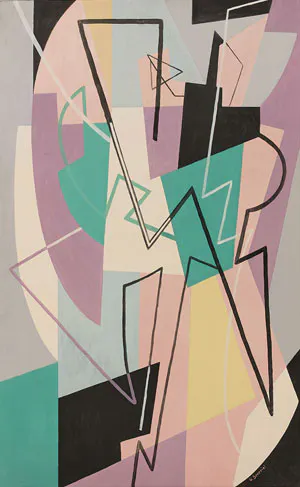
Gino Severini (1883-1966)
Le Chevalier et la Demoiselle (Ballet), 1952
Huile sur toile
120 x 76,50 cm
Estimation : 120 000 - 150 000 €
“A racing car whose boot is adorned with great tubes like snakes with explosive breath […] is more beautiful than The Winged Victory of Samothrace.” When he wrote the Manifesto of Futurism in 1909, Filippo Tommaso Marinetti advocated the rejection of past concepts of beauty and to turn exclusively towards the future which alone is worthy of being considered an example. Gino Severini was one of the first painters in the movement, along with Giacomo Balla, Umberto Boccioni, Carlo Carrà and Luigi Russolo. The latter borrowed from cubism the idea of fragmenting space, of deconstructing the order of elements, and of letting new forms interact with rhythms, colours, and lights to create a sensation of simultaneity and dynamism. French historian and art critique, Bernard Dorival, even said of Severini: “He was – and this is what made him original and even a genius – a bridge between futurism and cubism”.
“Le Chevalier et la Demoiselle (Ballet)”, Severini’s last work carried out in his studio in Meudon in 1952, inherited this principle. Effectively, several forms that call to mind Matisse’s cut-outs, dispersed across the canvas, bring together empty and full spaces, and juggle with a wide palette of colours – from yellow to violet, and green -. The black and white lines of varying thickness to the forefront, give an impression of movement, confirmed in the title which brings to mind a dance, a ballet between a knight and a lady. The Cubo-futurism at play in this work perfectly clarifies the influence of the movement on architecture which draws inspiration from this visual dynamism of lines, texture and the treatment of layout.
Nevertheless, Severini moved away from Cubo-futurism strictly speaking, sliding towards Abstraction. Effectively, it is a work typical of his later years, carried out in 1952, a period during which the Italian artist changed fundamentally, revealing himself as one of the masters of Abstraction. Futurism and the idea of the movement brought him to it: the quicker a body moves through space, more its perception is abstract. Thus, Severini explained in an interview with Georges Cattaui in Switzerland, around 1950: “In Byzantium, it was understood that an overly material representation of reality was detrimental to the religious mind[...]. Today, we have taken the opposite path by coming back to Abstract art. For my part, I came to it in the early days of cubism, with the division of shapes reduced to their essential elements”. “Le Chevalier et la Demoiselle (Ballet)”, demonstrates this shift and asserts its place as a work that is important to the comprehension of the history of art in the 1950s.
Informations
Exhibition in Paris:
Friday 30th November 11am – 7pm
Sunday 2nd December 11am – 7pm
Monday 3rd December 10am – 2pm
Auction in Paris
Monday 3rd December 2018 – 8pm
Auction Contact
Elodie Landais
Tél. +33 1 42 99 20 84