
Fontana’s “Clown”
Even though Lucio Fontana emphatically defined himself as a sculptor and not a ceramist, his interest in the subject is clearly visible in his practice of ceramics, which he expanded in 1937 during a stay at the Manufacture Nationale de Sèvres and, later, Albisola brickworks in Liguria (Italy). This
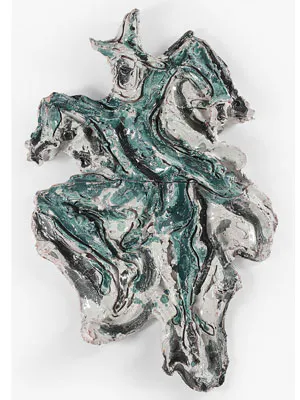
Lucio Fontana (1899-1968)
Pagliaccio, 1949-50
Glazed ceramic (in two parts)
100 x 75 cm
Estimation : 800 000 - 1 200 000 €
Even though Lucio Fontana emphatically defined himself as a sculptor and not a ceramist, his interest in the subject is clearly visible in his practice of ceramics, which he expanded in 1937 during a stay at the Manufacture Nationale de Sèvres and, later, Albisola brickworks in Liguria (Italy). This same interest is also visible in many of the Italian-Argentinian artist’s written works which constantly remind us of his position on the expression of shape and his desire to free it up by all means. This great inventor of space effectively aimed to create "a new art more in harmony with a period’s spiritual needs".
With ceramics, Lucio Fontana touched upon a myriad of subjects: marine animals, landscapes, religious topics and even characters from the Commedia dell’ Arte. Thus this "Pagliaccio" (clown in Italian) carried out in 1949-50 seems to mischievously relate the dislocation of the body, that of a clown who tries somehow to wield his cumbersome costume in a way that will magnify his status. "Pagliaccio" should be considered in all its volume. Effectively, Fontana is considered, first and foremost, a sculptor who worked with material and reconstituted space. Thanks to its plasticity, ceramics allowed him to express the clown’s movement, alternating convex and concave shapes. Two colours accentuate this formal dichotomy: contrasting green and white, one outlines the other, its texture making it even more significant. The reflections that fall across the colours bring them to life, make them shine and enhance the sculpture with an organic dimension which is on the borderline of the living.
The clown, by conveying a certain collective joyfulness, turns out to be a multi-faceted character. In 1930s Italy, the Fratellini trio was extremely popular, leaving a lasting mark on the circus with its audacity and tomfoolery, possibly inspiring Lucio Fontana a few years later. In choosing this subject, the latter also brought together different literary references (Marivaux and Molière, and also his contemporaries in authors’ theatre, such as Jacques Copeau and Dario Fo who rediscovered Commedia dell’Arte). It is also very much part of the history of art from Watteau to Picasso. Thus "Pagliaccio" shines a new light, for example, on Toulouse Lautrec’s painting "La clownesse Cha-u-kao au Moulin Rouge" (1895). The painter also portrays these same quantities of material occupying a disproportionate part of the work and which stands out compared to a frail body that seems to be dreaming of elsewhere. Toulouse Lautrec highlighted what we decipher in Fontana’s ceramic: a face adorned with a headdress that marries panache and disproportion that Fontana shows in the characteristics of an informal shape. The two characters’ postures and costumes reveal that these are stage characters and here the plot thickens: what part of the narrative are they hiding, what natural aspects are hidden behind the dramatisation? With Lucio Fontana, the question focuses on the whole character: alone, in three dimensions, thanks to ceramics techniques, the clown is shown in the truth of its shape and calls to be considered beyond its abstraction and its movement. By using a traditional technique, Lucio Fontana tried to shape space and revealed himself very much as an avant-gardist: the return of ceramics to Contemporary Art therefore pinpoints Pagliaccio as a perfect example of a timeless work.
Informations
Exhibition in Paris:
Friday 30th November 11am – 7pm
Sunday 2nd December 11am – 7pm
Monday 3rd December 10am – 2pm
Auction in Paris :
Monday 3rd December 2018 – 8pm
Auction Contact
Vanessa Favre
Tél. +33 1 42 99 16 13